Summary
- The MeerKAT radio telescope detected FRB 20240304B on March 4, 2024, and precisely localized the millisecond radio flash.
- Webb identified its host as a low-mass, clumpy, star-forming galaxy at a redshift of 2.148, corresponding to about 3 billion years after the Big Bang.
- The host is markedly smaller than the galaxies associated with most previously localized fast radio bursts.
- The finding favors a source capable of forming quickly in a young galaxy, but it does not conclusively establish what produced the burst.
A record-setting burst
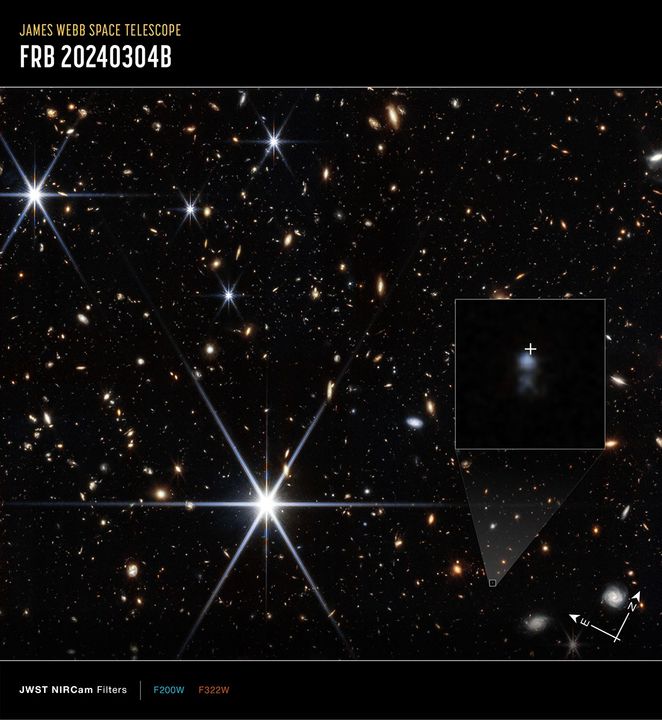
NASA's James Webb Space Telescope has identified the host galaxy of FRB 20240304B, the most distant fast radio burst localized so far. The MeerTRAP project first detected the brief radio signal with South Africa's MeerKAT telescope on March 4, 2024, but even the largest ground-based optical telescopes could not initially reveal a galaxy at the burst's precisely measured position. [1] [2] [3]
Webb's Near-Infrared Camera detected a faint galaxy at the location, while its Near-Infrared Spectrograph measured a redshift of 2.148, with a reported uncertainty of 0.0013. That places the burst about 3 billion years after the Big Bang, during the period of peak cosmic star formation. The study was published Oct. 8 in the journal Science. [1] [2]
An unexpected host galaxy
The observations show that the host is a low-mass, clumpy galaxy undergoing rapid star formation. NASA said it was roughly 1,000 times less massive than researchers had expected from previously studied fast-radio-burst hosts, which are commonly more massive star-forming galaxies. Independent reporting described the source galaxy as young, small and relatively poor in heavy elements. [1] [3]
That environment informs, but does not settle, the debate over what creates fast radio bursts. A merger between two neutron stars generally requires a long evolutionary delay, while a young, highly magnetized neutron star known as a magnetar can form soon after a massive star explodes. The research team said the young host makes a merger unlikely in this case, but the precise emission mechanism remains unconfirmed. [1] [3] [4]
A probe of otherwise invisible matter
Fast radio bursts last only milliseconds, but their signals are altered by ionized gas and magnetic fields encountered during their journey. The Science paper says FRB 20240304B crossed about 80% of cosmic history, allowing researchers to examine matter along an unusually long line of sight. The signal carried evidence of both the nearby Virgo Cluster and a previously unknown intervening galaxy cluster about 3.5 billion light-years away. [1] [2] [3]
Researchers expect MeerKAT to find additional bursts beyond redshift 1, while newer radio facilities could increase the discovery rate. Webb will remain important for identifying the faint host galaxies and measuring their distances, turning more of the brief radio flashes into probes of galaxy evolution and the diffuse cosmic web. [1] [4]
Reporting sources
- NASA · Webb Measures Distance to Farthest Fast Radio Burst, Suggesting Origin ↗2026-10-08
- Science via PubMed · A fast radio burst at redshift 2, three billion years after the Big Bang ↗2026-10-08
- The Guardian · Astronomers detect mysterious burst of energy from a galaxy far, far away ↗2026-10-08
- Max Planck Institute for Radio Astronomy · Record-breaking fast radio burst ↗2026-10-08
This article follows our editorial standards. To report an error, see our corrections policy.