Summary
- LFM3 launches with six models built from a shared 1.7B-parameter base.
- The text model has a 256K context window and fits in about 1 GB at 4-bit precision.
- Weights are available through Hugging Face, alongside Liquid AI's API and playground.
One small-model family across modalities
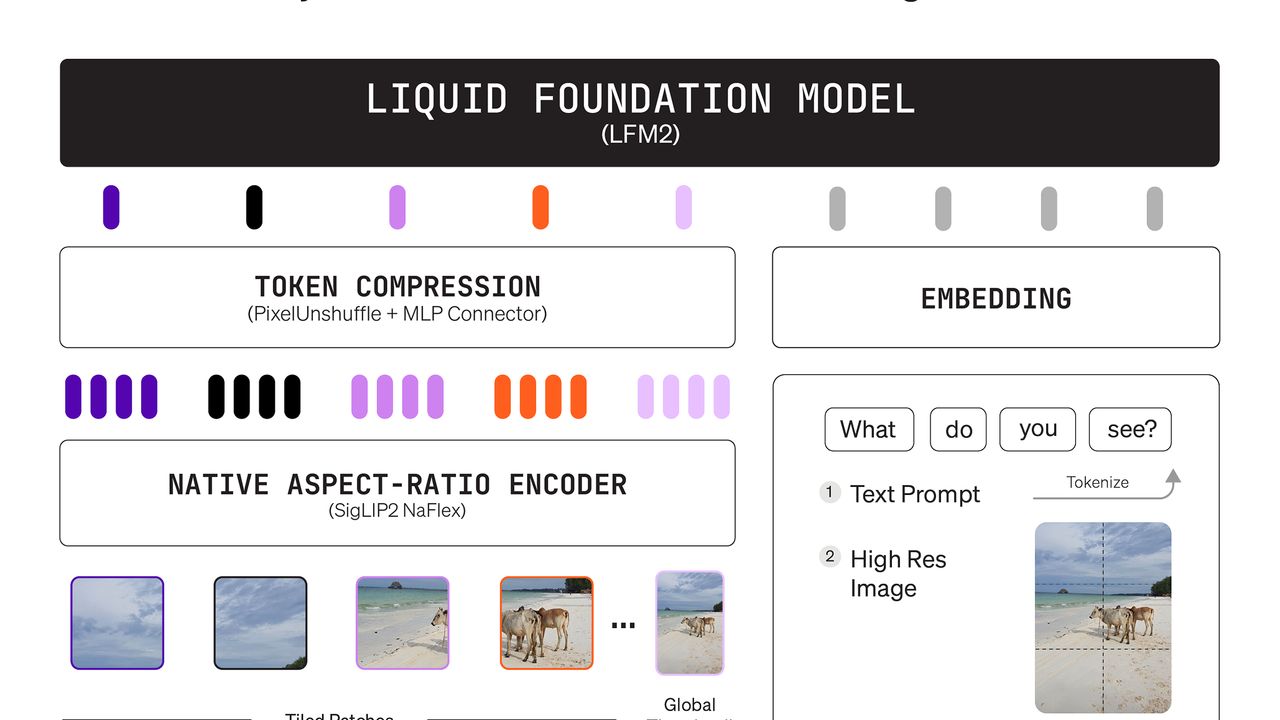
Liquid AI released LFM3, a family of six roughly 2-billion-parameter models spanning text, vision, audio, combined modalities and structured decisions. The models share a 1.7-billion-parameter base and are intended to be fine-tuned for specialized tasks instead of serving as one very large general-purpose system. [1] [2] [3]
The company says the text model supports a 256,000-token context window and can fit in about 1 GB when quantized to 4-bit precision. Liquid AI also says each model can be fine-tuned on a single GPU and deployed across Apple, AMD, Nvidia and Qualcomm hardware through common inference frameworks. [1] [2]
Open weights with licensing limits
Model weights are available through Hugging Face, Liquid AI's playground and its API. The family includes separate text, vision, audio, omni and decision variants. Hugging Face describes the release as a way for developers to select the modality they need, customize it with their own data and run it where the application operates. [1] [2]
Open-weight does not mean unrestricted open source. Independent coverage of the license notes that organizations with at least $10 million in annual revenue need a separate commercial arrangement. Businesses should review license terms, data rights and deployment costs before choosing the model for a product. [3]
Claims still need independent testing
Liquid AI says LFM3-1.7B outperforms its older 2.6-billion-parameter model while using 35% fewer parameters. Those benchmark results come from the company and its selected tests. A smaller model can reduce latency and cost, but accuracy on a specific workflow depends on prompts, fine-tuning data, quantization and hardware. [1] [3]
For teams evaluating LFM3, the useful next step is a task-level comparison against an existing model: measure quality, failure modes, speed, memory use and total maintenance work on representative private data. The release broadens the edge-AI toolset, but deployment evidence will determine where it is genuinely more efficient. [1] [2] [3]
Potential business uses
Small multimodal models can be attractive for customer support classification, visual inspection, in-vehicle assistants and private document tools where latency, connectivity or data location make a large remote model impractical. Fine-tuning one shared family may also simplify teams that need text, audio and image capabilities across several devices. [1] [2] [3]
The tradeoff is that specialization moves more responsibility to the deployer. Teams must collect representative data, evaluate bias and safety, manage model updates and decide when a request should be escalated to a more capable service or a person. Small size lowers some infrastructure barriers but does not remove product governance. [1] [2] [3]
Reporting sources
- Liquid AI · Introducing LFM3: Every modality for specialized intelligence ↗2026-10-27T00:00:00Z
- Hugging Face · Build specialized multimodal models with LFM3 ↗2026-10-27T00:00:00Z
- TSN · Liquid AI releases LFM3, six small open-weight models ↗2026-10-27T00:00:00Z
This article follows our editorial standards. To report an error, see our corrections policy.