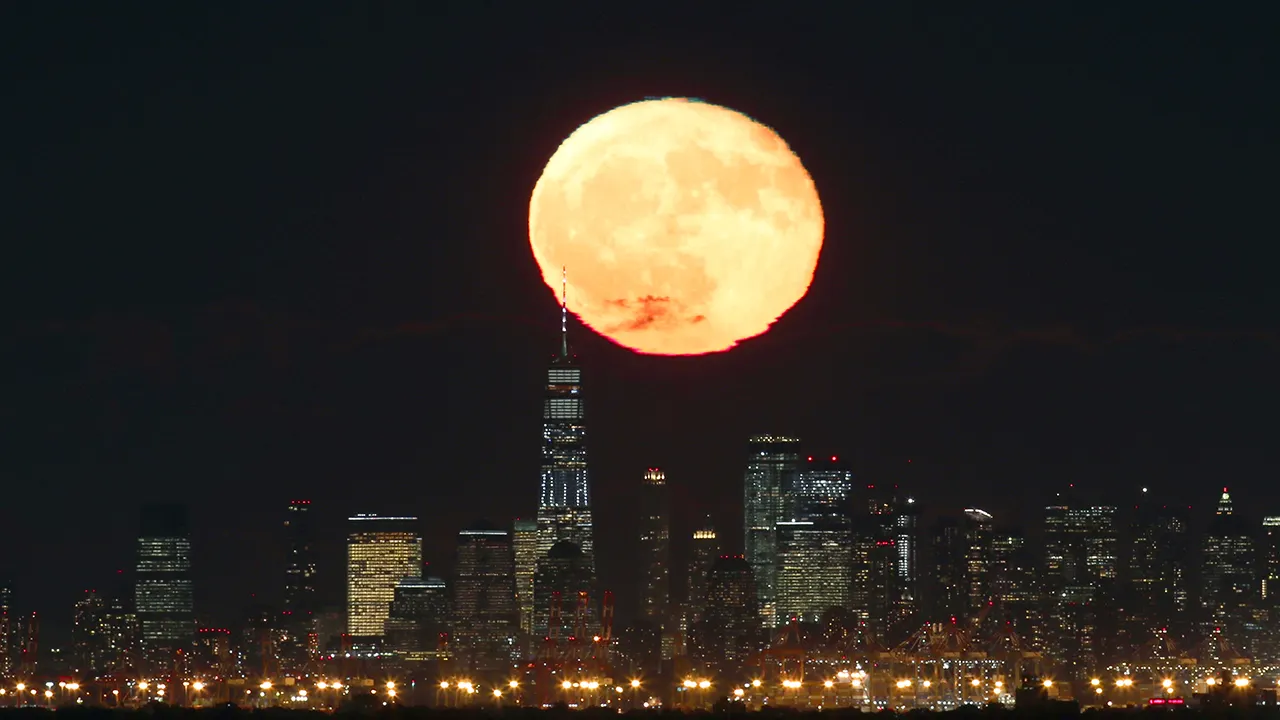
Summary
- The full Moon occurred at 12:12 a.m. EDT on October 26, or 9:12 p.m. PDT on October 25.
- The Moon remains bright after the exact full phase, though it is now waning; local moonrise times and weather determine the view.
- The Hunter’s Moon is a traditional Northern Hemisphere name for the full Moon following the Harvest Moon.
When the Hunter’s Moon reached full phase
October’s Hunter’s Moon reached its exact full phase at 12:12 a.m. Eastern Daylight Time on Monday, October 26. Across the continental United States, that same instant fell on Sunday, October 25: 11:12 p.m. Central, 10:12 p.m. Mountain and 9:12 p.m. Pacific daylight time. The Royal Observatory Greenwich lists the event at 4:12 a.m. GMT on October 26, and Astronomy magazine gives the Eastern time. [1] [2]
The precise moment is not the only chance to enjoy the Moon. NASA says a full Moon can appear full for a couple of days. After the October 26 peak, it enters the waning gibbous phase: much of its visible face remains illuminated, but the lit portion gradually shrinks as the Moon continues its orbit. [3] [4]
For viewers looking up on the evening of October 26 or in the early hours of October 27, the important distinction is that the Moon is past full, not reaching its peak again. Astronomy magazine estimated 99% illumination at 10 p.m. local time on October 26 for a reference location at 40 degrees north, 90 degrees west; conditions and local timing will differ elsewhere. [2]
How to look for it
A full Moon typically rises around sunset and sets around sunrise, according to NASA. As the phase wanes, moonrise gets later each night. Check a local moonrise forecast, find an open view toward the horizon, and allow for clouds, buildings or hills that may hide the Moon when it is low. The Moon is bright enough to see without a telescope. [4] [5]
Binoculars or a telescope can reveal surface features, but the full Moon’s direct illumination casts short shadows, making some craters look less three-dimensional. Astronomy suggests looking for the bright rays of material around impact craters, including Tycho in the lunar south, which can stand out particularly well near full phase. [2] [5]
For a phone photograph, NASA recommends steadying the device, turning off the flash, tapping the Moon to focus and lowering the brightness so surface details are not washed out. A foreground tree or building can give the picture context, while twilight can reduce the contrast between the bright Moon and the sky. [6]
Why it is called the Hunter’s Moon
The name is a seasonal tradition, not a separate astronomical phase. NASA connects it to hunters using bright moonlight to track game as autumn fields became bare and daylight faded. The October full Moon follows September’s Harvest Moon in 2026; the Royal Observatory lists both names in its calendar. [1] [3]
Full Moon names vary among cultures and traditions, and the dates shift from year to year. What does not change is the underlying geometry: at full phase, the Moon lies opposite the Sun from Earth’s perspective, allowing us to see almost all of its sunlit near side. The next full Moon on the observatory’s 2026 calendar is November 24, known as the Beaver Moon. [1] [4]
Reporting sources
- Royal Observatory Greenwich · When is the next full Moon? Full Moon Calendar 2026 ↗2026-10-27
- Astronomy · The Sky Today on Monday, October 26: Observe the October Hunter’s Moon ↗2026-10-26
- NASA · Disappearing Planets, Dragon Fireballs, Hunter’s Moon Fill October’s Spooky Skies ↗2026-10-05
- NASA Science · Moon Phases ↗2026-10-27
- NASA Science · Moon Viewing Tips ↗2026-10-27
- NASA Science · Lunar Photography Guide ↗2026-10-27
This article follows our editorial standards. To report an error, see our corrections policy.